
Food and Drink
Why Is Pineapple Cake So Famous in Taiwan? History, Meaning, Brands and How to Buy the Best
Nov
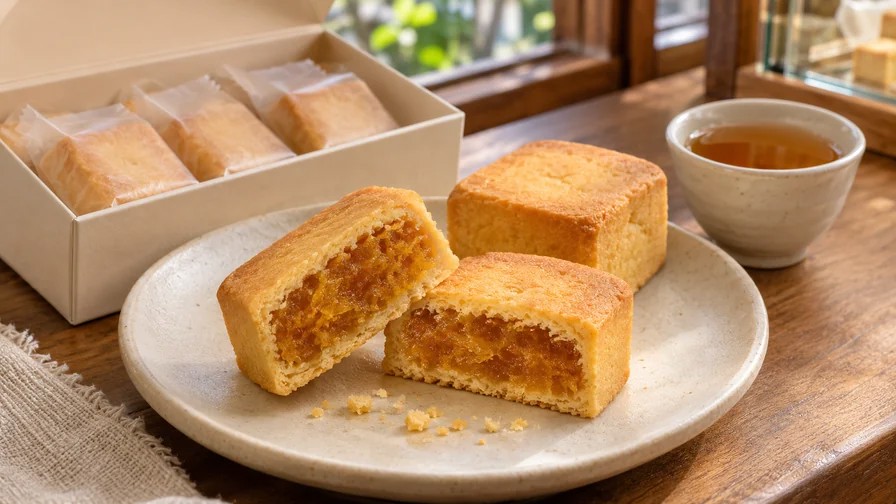
At a pastry shop in Taipei, lift the lid of a gift box and peel open one of the little wrappers. The buttery crust breaks at a corner, leaving crumbs on your fingers. In the middle is a seam of jam, softly sweet in one cake and tart enough to make you pause in another. The pineapple cake Taiwan is known for became famous because it carried a wish for prosperity and gave bakers a use for the island’s abundant pineapples. Gift boxes, competing bakeries and Taipei’s tourism promotion turned it into a signature souvenir.
How the pineapple cake Taiwan is known for became a signature gift
- The pineapple carries a wish. Its name in Hokkien sounds like “prosperity arrives,” giving the pastry a meaning that fits weddings, engagements and gifts.
- Taiwan had pineapples to spare. A large pineapple industry and a surplus from the 1970s gave bakers a reason to find more uses for the fruit.
- Taipei promoted the pastry to visitors. The city’s Pineapple Cake Cultural Festival gave bakeries a public showcase and promoted sales through tourism.
- The box made it easy to share. Individually wrapped pastries work as a formal gift and can also be passed around among people who want to try one.
- Bakeries gave shoppers a real choice. Festival contests put makers in direct competition, and the contrast between a smooth winter-melon blend and a tart pineapple filling gave shoppers a reason to compare.
Why a pineapple means good luck at a Taiwanese wedding
The pastry is called 鳳梨酥 (fènglí sū). In Hokkien, pineapple is ông-lâi, which sounds like “prosperity arrives.” The resemblance gives the fruit its lucky association. Put pineapple into a pastry and the wish goes with it, whether the cake is part of a wedding gift or in a box someone brings home from a trip. [1]
At a wedding or engagement, the wish has a particular recipient. Giving the pastry is a way of wishing the couple prosperity as they begin their life together. That makes the cake an apt gift even before anyone opens the box. The Hokkien wordplay also helps explain why the pastry could carry its meaning from a family ceremony into an everyday exchange between friends.
The history of Taiwanese pineapple cake, from wedding pie to gift box
Before the little square, there was a round wedding pastry
Accounts in Taipei Times and Taiwan News describe an earlier ceremonial pastry that was larger and round. The change in size is easy to picture at a wedding. A round pie set out for the occasion needs to be divided, while a small square arrives ready to hand to a guest.
According to the Yen Shin-Fa bakery family in Taichung, as reported by Taiwan News, Yen Shu-mu took the large round pie and made it small and square. In the family’s telling, he used a crumbly, butter-based crust and kept the pineapple and winter-melon filling. The account gives a specific example of how the shape and crust may have evolved. [2]
Japanese-era canning built the pineapple industry
The agriculture has a clearer timeline. Taiwan’s pineapple industry expanded substantially under Japanese rule, from 1895 to 1945. By the late 1930s, Taiwan was the world’s third-largest pineapple exporter. The scale of that industry matters to the pastry’s story because it shows how much fruit Taiwan could produce before the modern gift-box trade developed. [3]
Government figures cited by AmCham Taiwan put canned pineapple output at about 1.6 million cases a year from 1938 to 1940. It fell to about 22,500 cases in 1945, then peaked at about 4 million cases in 1971, the highest output in the world that year. Those figures track cans, and they help explain the abundance of fruit available to the industry by the 1970s.
The 1970s surplus gave bakeries an opening
From the 1970s, Taiwan turned its attention toward the domestic pineapple market. AmCham Taiwan and Goldthread describe a surplus that pushed bakers to use the fruit in pastries. That helps explain how a pastry associated with ceremonies could find a wider market. Once a bakery could sell the little cakes by the box, a customer could give that box away on any ordinary visit. [4]
What historians and sources disagree on
When pineapples arrived. AmCham Taiwan puts their arrival as early as the mid-17th century. Goldthread describes their arrival as roughly 250 years before its report. The accounts give different timelines. [4]
When the cake took shape. AmCham Taiwan notes that some accounts put its history at more than a century, while others trace the modern pastry to the surplus of the 1970s. The Taichung bakery family offers its own account of the small, butter-crusted square. The exact date the familiar pastry first appeared remains debated. [2]
How Taipei’s festival moved the cake into the souvenir economy
In the mid-2000s, Taipei’s city government began running an annual Pineapple Cake Cultural Festival to promote tourism and sales. Sources differ on the start year. The event put bakeries in competition and gave visitors a public introduction to a pastry they could buy in a box and take home.
The reported sales figures show the scale people attributed to the boom. Taiwan Today, citing the Taipei Bakery Association, put industry revenue at about NT$2 billion in 2006 and NT$25 billion in 2010. AmCham Taiwan, quoting the then Taipei mayor, gave a 2006 figure of NT$3 billion and a 2013 figure of NT$40 billion, or about US$1.2 billion. These are published estimates. Their different starting figures make it hard to combine them into a single growth rate. [5] [6]
Tourism also shaped who bought the pastry. In 2016, AmCham Taiwan reported that mainland Chinese tour groups were the biggest buyers at the time. In October 2021, Taiwan News reported new Chinese import registration requirements affecting Taiwanese pineapple cake exporters, following a March 2021 ban on fresh Taiwanese pineapples. [7]
The festival promoted a souvenir with an obvious use once visitors got home. The person who receives a gift box can set a few pieces out with tea and leave the others wrapped. That practicality helps explain the appeal of one of Taiwan’s top-selling souvenirs.
Winter melon versus pure pineapple, bite by bite
The winter-melon blend is smooth and sweet
Winter melon costs less than pineapple, and bakers found that blending it in softened the filling’s texture and made it easier on the palate. In a bite, the jam tends to feel smoother and taste sweeter than a pure-pineapple filling. If you like a soft centre and a gentler fruit flavour with the buttery crust, start with this style.
Critics see winter melon as a cheaper filler that mutes the pineapple. Defenders point to the blended filling’s place in traditional baking and value the smoothness it gives the pastry. Both reactions make sense when you know what the person wants from a bite. Try the blend on its own, and ask whether you like the gentler filling enough to choose it again.
Pure pineapple gives you more tartness and fibre
Look for 土鳳梨酥 or 純鳳梨酥, labels often used for pure-pineapple cakes, and confirm the filling on the ingredient list. Here the jam is generally tarter, and you can feel the fruit fibres as you chew. If you want the pineapple’s acidity to come through clearly against the butter, this is the style to sample first. [8]
SunnyHills is one example of a maker using Taiwan-grown Cayenne pineapple without winter melon in the filling. With pineapple as the sole fruit in the jam, the fruit’s tartness and fibre are part of what you’re choosing. Check the specific maker’s description if the variety is something you want to compare, as the pure-pineapple label describes the filling style. [9]
Six well-known Taiwanese pineapple cake makers
Editorial overview, check current prices.
| Maker | Style | Filling | Best for |
|---|---|---|---|
| Chia Te Bakery | Classic blended style | Pineapple and winter melon | A smooth, sweeter first taste |
| SunnyHills | Pure-pineapple style | Taiwan-grown Cayenne pineapple, without winter melon | A tarter, more fibrous first taste |
| Kuo Yuan Ye | Also well known | Check the product label | Adding another maker to a tasting |
| Lee Hu | Also well known | Check the product label | Adding another maker to a tasting |
| Yu Jan Shin | Also well known | Check the product label | Adding another maker to a tasting |
| Wu Pao-Chun | Also well known | Check the product label | Adding another maker to a tasting |
Chen Tang-peng founded Chia Te Bakery in Taipei in 1975. The bakery won first prize for original pineapple cake at the first Taipei festival, reported as taking place in 2006. A food blogger reports that Chia Te describes its classic filling as 80% winter melon and 20% pineapple. Treat that as a reported ratio and use the box in front of you to check ingredients. [10] [11] [12]
For a comparison you can taste, start with the classic Chia Te and the original SunnyHills and try them side by side. If you add another maker, read the label for the particular pastry you pick. The four other names above are also well known, and their catalogues are places to check what’s available.
How to tell if a pineapple cake is worth buying
Start with the crust. Bite across an edge where you can get pastry and jam together. Look for a clear buttery aroma and a crumb that breaks easily under your teeth. If two samples have similar fillings, the texture of the crust may be the detail that settles your choice.
Then pay attention to the filling. In a blended cake, notice whether you can still pick out pineapple through the softer sweetness. In a pure-pineapple cake, decide how much tartness and chew you want. Take another bite after a sip of tea before settling on a box.
Check freshness on the package you’ll actually take home. Read the printed date and storage instructions, especially if the cake is a gift for someone you’ll see after your trip. For ingredients, look for pineapple and winter melon by name, and ask the shop about anything you need to confirm before buying.
Quick checklist
- Sample a piece if the shop offers one.
- Look for a buttery crust that breaks into a tender crumb.
- Choose the jam texture and tartness you want.
- Confirm the filling on the ingredient list.
- Check the dates, storage instructions and condition of the wraps.
Three Taiwanese teas to try with pineapple cake
Tea is a traditional companion to pineapple cake. Taipei Times reported that many shops offer complimentary samples with hot tea. If you’re tasting at home, try one of these combinations and sip the tea between bites so you can notice what carries through. [13]
- Light Taiwanese oolong with pure pineapple. Try a lightly brewed cup if you want to keep the jam’s tartness and fruit flavour in the foreground.
- Roasted Taiwanese oolong with a winter-melon blend. Try it when you want a toasted note alongside the buttery crust and smooth, sweet centre.
- Taiwanese black tea with a rich, buttery cake. Pour it plain for a firmer-tasting sip between bites, especially if the filling tastes particularly sweet to you.
Where to buy pineapple cake in Taiwan and how to bring it home
Start at a bakery and taste before buying a gift box
In Taipei, Chia Te is a starting point for a classic blend, and SunnyHills is a starting point for pure pineapple. At a bakery or pastry shop, ask whether you can sample the filling style you’re considering. Check the maker’s current shop details and product availability before making a special trip.
Buy for the people you’ll see
Count the people or households you want to give cakes to and decide which boxes will be handed over whole. If the cakes are for sharing around a table, count the individually wrapped pieces in the box. Leave room in your luggage for each box and think about when the last recipient will get theirs.
Read the shelf life on the box you choose
Retail listings put some SunnyHills pure-pineapple boxes at about 45 days. One retailer lists a winter-melon blend at up to six months. Those figures describe particular products. Use the date and storage instructions on the exact box you buy, and ask the retailer to clarify them if needed. [14] [15]
Keep the packaging and check customs before you leave
Keep the cakes in their original boxes, with ingredient labels and individual wrappers intact. Pack the boxes somewhere they’re easy to reach and protected from heavier luggage. If you’re giving them away, the label also lets the recipient read the ingredients and storage instructions.
Many customs systems generally allow commercially packaged pastries, but verify the rules with your destination’s official customs or biosecurity authority before buying. Check any packaging and quantity limits that apply and declare the cakes as food when you arrive, following the authority’s instructions.
Frequently asked questions
Is Taiwanese pineapple cake actually made of pineapple?
Yes. It contains pineapple jam. Many traditional versions blend pineapple with winter melon for a smoother, sweeter centre. If you want pineapple as the only fruit in the filling, look for 土鳳梨酥 or 純鳳梨酥 and confirm on the ingredient list.
Is Taiwanese pineapple cake the same as a pineapple tart?
If a shop calls its pastry a pineapple tart, check the description. The Taiwanese pastry in this guide is 鳳梨酥 (fènglí sū), a small buttery pastry with pineapple jam inside the crust. The ingredients can also tell you whether winter melon is blended into the filling.
Is Chia Te or SunnyHills better for a first box?
Try Chia Te’s classic cake for the smoother, sweeter pineapple and winter-melon blend. Try SunnyHills if you prefer the tartness and more noticeable fibre of a pure-pineapple filling. Tasting the two styles side by side is a direct way to find your preference.
How long does Taiwanese pineapple cake last?
Check the printed date and storage instructions on the box. Some retailer listings put SunnyHills pure-pineapple cakes at about 45 days, and one winter-melon blend listing gives up to six months. Use the date on your box to decide whether it will keep until you plan to eat or give it away.
Can I bring Taiwanese pineapple cakes home in my luggage?
Check your destination’s official customs or biosecurity rules before you travel. Commercially packaged pastries are often permitted, subject to the destination’s requirements. Keep the original packaging and declare the cakes as food when you arrive, following the official instructions.
What does pineapple cake mean as a gift in Taiwan?
It carries a wish for prosperity. The Hokkien word for pineapple, ông-lâi, sounds like “prosperity arrives.” That association makes the pastry a fitting gift for a wedding or engagement and gives a box of souvenirs a meaning the giver can pass on.
The box you bring home
Taiwan’s pineapple cake carries a wedding wish, an agricultural history and the work of bakers who turned it into a small, boxed gift. The filling is the best place to start when choosing one, whether you want the smooth sweetness of a winter-melon blend or the tart chew of pure pineapple. Before you buy, check the date on the box and think about when you’ll sit down to open it.
Sources
- TaiwanPlus — The Pineapple Cake Chronicles
- Taiwan News — Soothing Taiwan’s Sweet Tooth
- Wikipedia — Pineapple cake
- Goldthread — How to Make Taiwan’s Famous Pineapple Cake
- Taipei City Government — Pineapple cake festival and reported sales
- DineTaiwan — Pineapple cake history and AmCham’s reported revenue figures
- Taiwan News — Pineapple cakes and China’s 2021 import registration rules
- Taipei Tourism Guide — Pineapple cake styles and filling labels
- VICE — SunnyHills pineapple cake feature
- Taipei Travel — Chia Te Bakery profile
- United Daily News — Chia Te’s festival award
- Taiwan Obsessed — Chia Te’s reported filling ratio
- Taipei Times — The Story of Pineapple Cakes
- Night Market — SunnyHills shelf-life listing
- LAI HAO — Winter-melon blend shelf-life listing
