
Food and Drink, Desserts
8 Royal Desserts Around the World and Their Palace Stories
Oct
A piece of Mysore Pak and a slice of Victoria sponge look very different on a plate. One gets its character from roasted gram flour and ghee; the other pairs a buttery cake with fruit jam. Both have a connection to royalty, but their stories begin in different ways.
Royal desserts include sweets associated with palace kitchens, cakes named in honour of royal people, and dishes remembered through stories about emperors. Understanding those connections makes the subject more interesting than simply calling an elaborate dessert “fit for a king.”
This guide explores eight examples from Europe and Asia, looking at what they taste like, how they are made and which parts of their royal histories deserve a little caution.
Royal desserts at a glance
| Dessert | Country or tradition | Defining feature |
| Mysore Pak | India | Roasted gram flour and ghee |
| Baklava | Ottoman tradition | Thin pastry layers with nuts and syrup |
| Yakgwa | Korea | Fried honey pastry with sesame oil |
| Luk Chup | Thailand | Mung bean sweets shaped like tiny fruit |
| Victoria sponge | United Kingdom | Buttery sponge with jam |
| Prinsesstårta | Sweden | Cream layers under green marzipan |
| Sacher Torte | Austria | Chocolate cake with apricot jam |
| Kaiserschmarrn | Austria | Fluffy pancake torn into pieces |
Sweets associated with palace kitchens
1 Mysore Pak from India
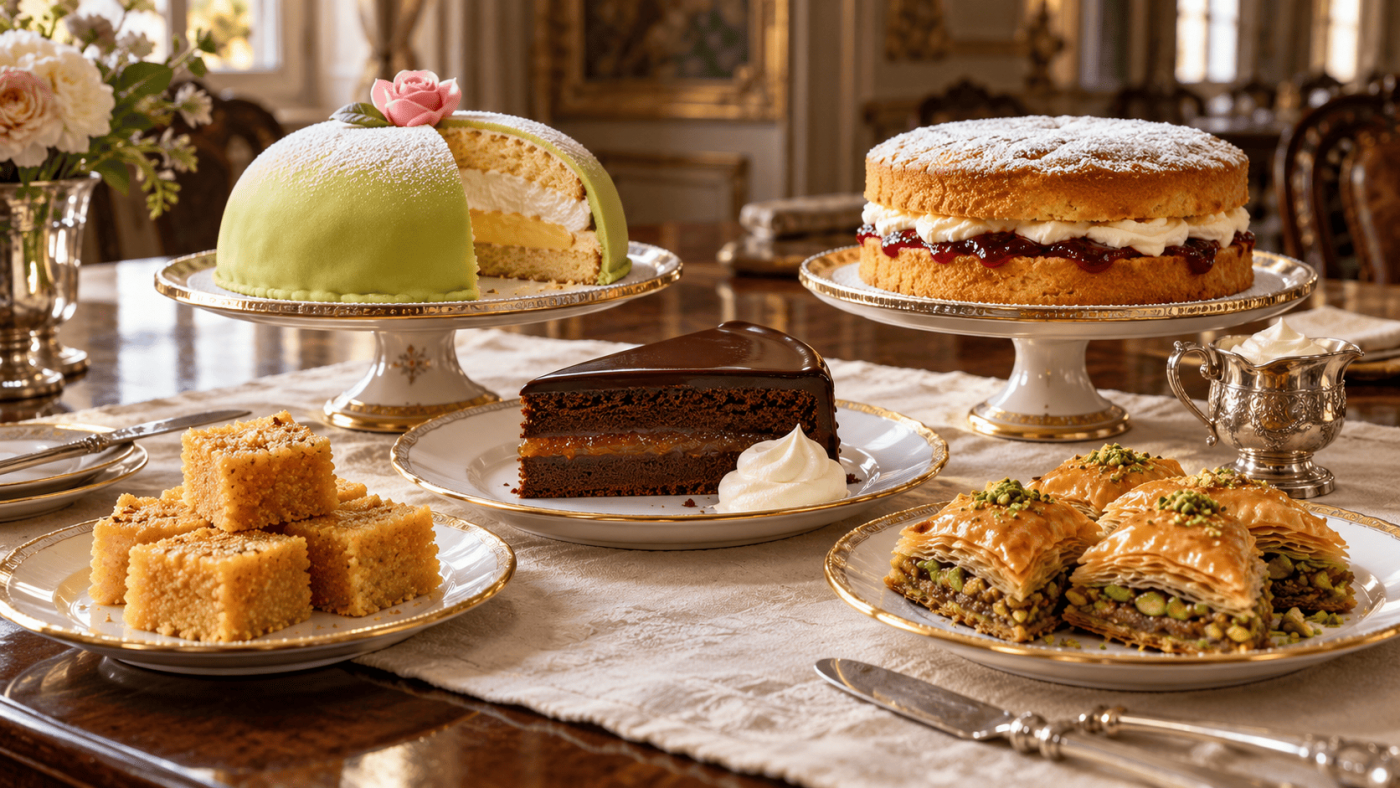
Mysore Pak begins with a short ingredient list: gram flour, sugar and ghee. Cooking them together produces a sweet with a roasted aroma and a richness that makes a small piece satisfying. Depending on the preparation, its texture can be porous and crumbly or softer and more yielding.
The familiar palace account credits Kakasura Madappa, a cook serving Maharaja Krishnaraja Wadiyar IV in Mysuru. Government and tourism descriptions preserve this connection, although the colourful conversations often added to the story are best treated as storytelling rather than a recorded exchange.
Its appeal lies in the cooking. The flavour of the flour and the handling of the ghee matter far more than decorative toppings. For someone accustomed to milk-based Indian sweets, it offers a distinctly different bite.
2 Baklava from the Ottoman tradition
Baklava has a royal connection through Ottoman palace dining and ceremony. One particularly memorable tradition involved the sultan sending trays of baklava to the Janissaries, the empire’s elite soldiers. Here, dessert was also a public gift with political meaning.
The pastry combines many thin sheets of dough with butter, nuts and a sweet soaking syrup. Pistachio and walnut versions offer different flavours, while the balance between crisp upper layers and a syrup-soaked base helps define the experience.
Baklava belongs to several overlapping regional food traditions, with recipes changing the choice of nuts, pastry and syrup. The Ottoman serving ceremony gives it a specific court connection within that wider history. It is a more reliable starting point than an account that credits every version to a single inventor.
3 Yakgwa from Korea
Yakgwa is a Korean sweet pastry associated with court refreshments and ceremonial food. Its dough commonly includes wheat flour, sesame oil and honey. After frying, the pieces are soaked in honey or syrup, giving them a sweet, dense bite.
The Korea Foundation’s account of Joseon court snacks includes yakgwa among the confections enjoyed at the palace. Its place in ceremonial dining gives this small pastry a history beyond the bakery counter, connecting it with the carefully prepared refreshments of the royal household.
Yakgwa may look like a biscuit, especially when pressed into a decorative shape, but the syrup changes what you should expect. It can be tender and chewy rather than dry and crisp. Sesame oil adds an aroma that distinguishes it from a plain sugar cookie.
4 Luk Chup from Thailand
A plate of Luk Chup can resemble a tiny fruit stall. The sweets are shaped and coloured to look like miniature mangoes, chillies and other produce, then finished with a glossy coating. Inside is a smooth mixture based on mung beans, coconut milk and sugar.
The Thailand Foundation connects Luk Chup with Ayutthaya’s royal food traditions and Portuguese influence. Its adaptation is often attributed to Maria Guyomar de Pina, also known as Thao Thong Kip Ma, but the foundation acknowledges that her precise role remains uncertain.
Making the sweets involves shaping each small piece, applying its colours and dipping it in glaze. The finished coating adds a delicate outer layer to the soft centre. Despite its fruity appearance, the filling tastes of sweet bean paste and coconut rather than the fruit it imitates.
Cakes connected with royal names and patrons
5 Victoria sponge from the United Kingdom
Victoria sponge is named after Queen Victoria. The Royal Household describes her habit of eating sponge cake with afternoon tea, giving this familiar bake a direct royal association.
Its basic appeal is the balance between buttery sponge and fruit jam. Cream or buttercream appears in many versions; the recipe shared by Buckingham Palace’s pastry chefs uses jam and vanilla buttercream. A light dusting of icing sugar leaves the cake itself visible.
The royal name does not mean every sandwich cake follows an unchanged Victorian formula. Fillings and proportions vary. When choosing one, look at the balance of cake and filling: a generous layer of cream creates a different dessert from a sponge with a restrained spread of jam.
6 Prinsesstårta from Sweden
Prinsesstårta, or Swedish princess cake, is recognisable by its rounded shape and green marzipan covering. Beneath it sit layers of sponge, vanilla custard and whipped cream. The marzipan contributes an almond flavour and a firmer outer layer against the soft filling.
Its royal link runs through Jenny Åkerström, a cookery teacher whose pupils included Swedish princesses. Her teaching and cookbooks connect the cake with that royal circle. The association adds a personal detail to the history of a dessert now recognised for its distinctive green covering.
For a dessert table, the interesting detail is the contrast between the neat exterior and the creamy interior revealed by a slice. Someone expecting an ordinary iced sponge may be surprised by how much of the cake’s character comes from its custard and cream.
7 Sacher Torte from Austria
Sacher Torte connects chocolate cake with the aristocratic world of nineteenth-century Vienna. Hotel Sacher traces its creation to 1832, when the young apprentice Franz Sacher prepared a dessert for Prince Metternich’s household after the chef became ill.
The distinction matters: Metternich was a prince and statesman, so this is a story of aristocratic patronage rather than a cake commissioned by an emperor.
Chocolate cake, apricot jam and a chocolate glaze give the dessert its identity. The jam introduces fruit acidity between the chocolate elements, while unsweetened whipped cream is the house’s suggested accompaniment. It offers a useful comparison with modern chocolate cakes that rely on thick cream fillings: here, the fruit layer is central to the flavour.
An imperial dessert surrounded by legends
8 Kaiserschmarrn from Austria
Kaiserschmarrn is a fluffy pancake cooked in butter, torn into irregular pieces and finished with sugar. It is commonly accompanied by fruit compote, which adds tartness to the warm, sweet pieces.
Austrian tourism sources connect it with Emperor Franz Joseph I, but accounts of its invention differ. Stories about a kitchen mistake or a rejected pancake belong to its folklore. The variety of accounts leaves its exact beginnings unresolved, even as its imperial association remains familiar.
Its presentation is a welcome surprise in a collection of royal desserts. There is no requirement for careful piping or a polished glaze. The attraction is in the freshly cooked pancake, its browned edges and the fruit served alongside it. It makes the strongest case here for eating dessert warm.
Choosing a royal dessert for your taste
Start with texture. Mysore Pak suits someone who enjoys roasted flavours and the richness of ghee. Baklava offers pastry layers and nuts, while yakgwa gives a denser, syrup-soaked bite. Luk Chup is an option for those drawn to coconut and small, carefully shaped sweets.
For a cake to share, Victoria sponge offers a familiar combination of butter and jam. Prinsesstårta puts cream and custard at the centre, while Sacher Torte gives chocolate lovers a fruit-accented alternative. If you prefer a warm dessert, Kaiserschmarrn belongs on your shortlist.
When ordering from a bakery, ask what its version contains. A modern cake inspired by a royal dessert can be enjoyable in its own right, but changes to the filling or covering may make it quite different from the traditional preparation. Choose the flavours you want to eat, then enjoy the history that comes with them.
